

Organized by the Artificial Intelligence and Design Club, founded by students of the Department of Interior Architecture and Environmental Design (Turkish & English) at Istanbul Gelişim University (IGU), Faculty of Fine Arts (FFA), the ARCH SUMMIT 26' – Architecture X Artificial Intelligence event was held with extensive sessions addressing the multi-faceted relationship between architecture and AI. The event drew significant interest from academics, students, and design enthusiasts, creating a vital academic platform to discuss the increasing role of AI technologies in architectural disciplines.
Today, the disciplines of architecture and interior architecture are undergoing a significant transformation driven by the advancement of digital technologies. Artificial intelligence, in particular, enables the redefinition of design processes, the development of data-driven decision mechanisms, and the acceleration of architectural production. In this context, ARCH SUMMIT 26' aimed to provide an interdisciplinary discussion platform by addressing the relationship between architecture and AI through both theoretical and application-based approaches.
The event served as a rich learning environment contributing to the academic and professional development of Interior Architecture and Environmental Design students, while offering valuable experience in organization and academic event management. Led by the Artificial Intelligence and Design Club, the event stood out for its participatory structure where students played an active role in encouraging academic exchange.
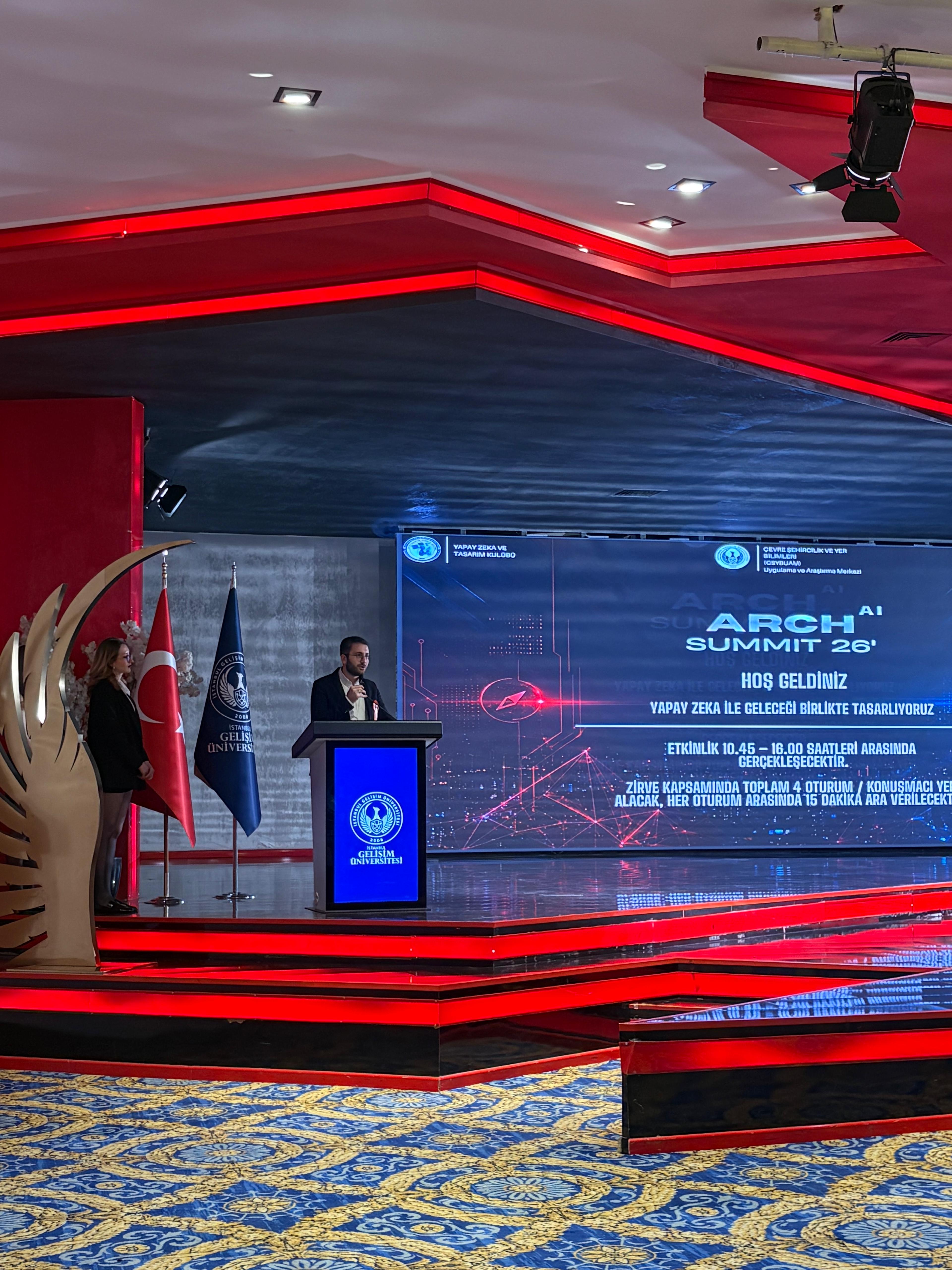
Opening Remarks and Scope of the Event
ARCH SUMMIT 26' commenced at 10:30 AM. The opening speeches emphasized the growing importance of AI technologies in architecture and design, noting that AI should be viewed not merely as a technical tool but as an approach that reshapes design thinking.
Key topics included the digitalization of architectural education, the prevalence of parametric design approaches, and the rising importance of data-based design processes. It was highlighted that AI technologies offer significant opportunities for increasing design alternatives, enhancing performance analysis, and strengthening sustainable design approaches in architecture and interior architecture. Furthermore, it was noted that using AI tools in education allows students to develop a more analytical, inquisitive, and interdisciplinary perspective.
Session I: Use of Artificial Neural Networks in Architecture
In the first session, held between 11:00–11:45 AM, Asst. Prof. Dr. Ece Cantemir delivered a presentation titled "The Use of Artificial Neural Networks in Architecture." The session provided a comprehensive look at integrating neural networks into design processes. Dr. Cantemir explained how machine learning algorithms can be utilized in architectural form generation, spatial analysis, and performance evaluation, providing systematic and data-driven advantages especially for energy efficiency and spatial optimization.
Session II: AI and the Future of Design
In the second session (12:00–12:45 PM), Derya Toros presented "AI and the Future of Design." This session explored how AI transforms creative processes and shapes future architectural practice. Highlighting generative design, Toros emphasized that AI will not replace designers but rather serve as a tool to support them, making it crucial for students to master these technologies for their future careers.
Session III: AI and the Transformation of Architecture
Following the lunch break, Ercan Durmaz conducted the third session (2:00–2:45 PM) titled "AI and the Transformation of Architecture." The discussion focused on the digital transformation of the profession, noting that AI tools accelerate project development and make design processes more efficient through advanced spatial organization and user experience analysis.
Session IV: AI Workflow in Architecture
The final session (3:00–3:45 PM), titled "AI Workflow in Architecture," was presented by Selman Can and Halil İbrahim Can. Using practical application examples, they demonstrated how AI tools can be integrated into different stages of the design workflow—from the initial concept phase to final application—speeding up decision-making and diversifying design alternatives.
A Student-Oriented Academic Event
ARCH SUMMIT 26' stood out as a significant student-led organization. Throughout the event, participants had the opportunity to engage with current approaches to the architecture-AI relationship within an interdisciplinary learning environment.
A Platform Contributing to the Future of Architecture and AI
The event concluded at 3:45 PM, having successfully demonstrated that AI is a transformative approach to design thinking rather than just a tool. From neural networks to generative design and data-driven workflows, the summit provided participants with new perspectives on the future of design.
By organizing such academic events, the Artificial Intelligence and Design Club supports active learning processes in architectural education and strengthens students' skills in tracking current technologies and academic event production. ARCH SUMMIT 26' successfully concluded as a comprehensive event that highlighted the importance of digital transformation in design while fostering academic interaction.
The event served as a rich learning environment contributing to the academic and professional development of Interior Architecture and Environmental Design students, while offering valuable experience in organization and academic event management. Led by the Artificial Intelligence and Design Club, the event stood out for its participatory structure where students played an active role in encouraging academic exchange.
Opening Remarks and Scope of the Event
ARCH SUMMIT 26' commenced at 10:30 AM. The opening speeches emphasized the growing importance of AI technologies in architecture and design, noting that AI should be viewed not merely as a technical tool but as an approach that reshapes design thinking.
Key topics included the digitalization of architectural education, the prevalence of parametric design approaches, and the rising importance of data-based design processes. It was highlighted that AI technologies offer significant opportunities for increasing design alternatives, enhancing performance analysis, and strengthening sustainable design approaches in architecture and interior architecture. Furthermore, it was noted that using AI tools in education allows students to develop a more analytical, inquisitive, and interdisciplinary perspective.
Session I: Use of Artificial Neural Networks in Architecture
In the first session, held between 11:00–11:45 AM, Asst. Prof. Dr. Ece Cantemir delivered a presentation titled "The Use of Artificial Neural Networks in Architecture." The session provided a comprehensive look at integrating neural networks into design processes. Dr. Cantemir explained how machine learning algorithms can be utilized in architectural form generation, spatial analysis, and performance evaluation, providing systematic and data-driven advantages especially for energy efficiency and spatial optimization.
Session II: AI and the Future of Design
In the second session (12:00–12:45 PM), Derya Toros presented "AI and the Future of Design." This session explored how AI transforms creative processes and shapes future architectural practice. Highlighting generative design, Toros emphasized that AI will not replace designers but rather serve as a tool to support them, making it crucial for students to master these technologies for their future careers.
Session III: AI and the Transformation of Architecture
Following the lunch break, Ercan Durmaz conducted the third session (2:00–2:45 PM) titled "AI and the Transformation of Architecture." The discussion focused on the digital transformation of the profession, noting that AI tools accelerate project development and make design processes more efficient through advanced spatial organization and user experience analysis.
Session IV: AI Workflow in Architecture
The final session (3:00–3:45 PM), titled "AI Workflow in Architecture," was presented by Selman Can and Halil İbrahim Can. Using practical application examples, they demonstrated how AI tools can be integrated into different stages of the design workflow—from the initial concept phase to final application—speeding up decision-making and diversifying design alternatives.
A Student-Oriented Academic Event
ARCH SUMMIT 26' stood out as a significant student-led organization. Throughout the event, participants had the opportunity to engage with current approaches to the architecture-AI relationship within an interdisciplinary learning environment.
A Platform Contributing to the Future of Architecture and AI
The event concluded at 3:45 PM, having successfully demonstrated that AI is a transformative approach to design thinking rather than just a tool. From neural networks to generative design and data-driven workflows, the summit provided participants with new perspectives on the future of design.
By organizing such academic events, the Artificial Intelligence and Design Club supports active learning processes in architectural education and strengthens students' skills in tracking current technologies and academic event production. ARCH SUMMIT 26' successfully concluded as a comprehensive event that highlighted the importance of digital transformation in design while fostering academic interaction.